Editor score 4.2 / 5
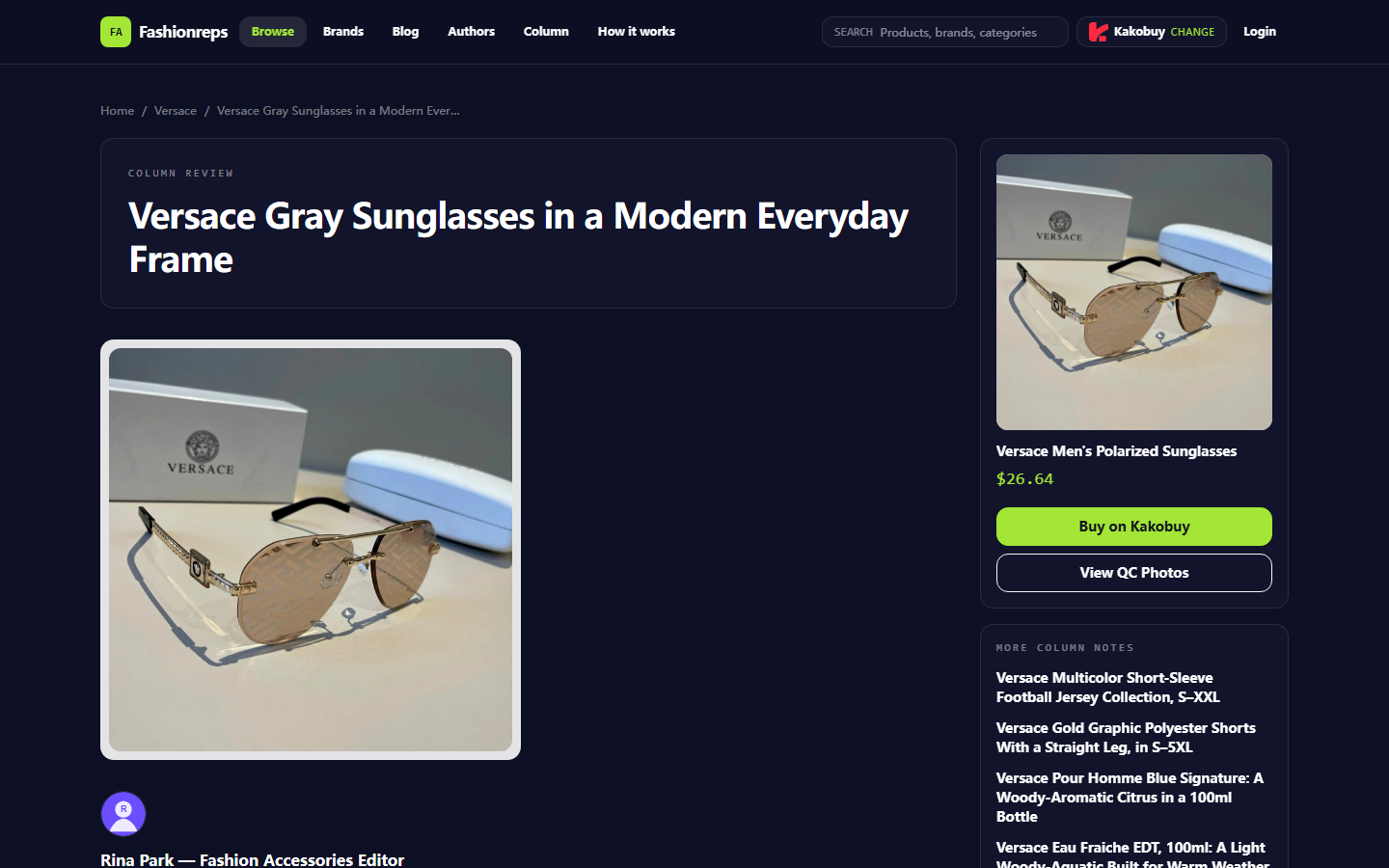
Before buying a pair of Versace sunglasses, the real issue to solve first isn't "do the pictures look good," but whether the product page provides enough evidence for you to verify the lens description, frame proportions, wearing size, and detail condition. This article uses the Versace gray polarized sunglasses product listing on fashion-reps as a sample to help you complete a reviewable page check before placing an order. 🕶️
As of September 26, 2026, the page shows a reference item price of $26.64, with a final item price record of $28.95; service fees and international shipping need to be confirmed separately on the shopping agent page. Prices, stock, variants, and link status should all be rechecked before actually ordering.
Clarify the Single Verification Task Before Buying Versace Sunglasses
This check focuses on one task: determining whether the current page is sufficient to support your choice of these sunglasses, or whether you should ask for more information before buying.
After reading, you should be able to take one of three actions:
- Continue with the purchase and save the page evidence you've already verified.
- Ask the seller or shopping agent for additional details on size, material, variant, or lens specifics.
- Pause when key information is missing, and don't substitute a promotional image for necessary evidence.
This content does not apply to purchases that require confirming authenticity authorization, prescription lens parameters, or professional optical performance. Product pages and public discussions can only help you with pre-purchase screening, not replace brand authentication, optometry, or in-store inspection.

Record Style, Color, Size, and Link from the fashion-reps Product Page
fashion-reps plays the role of a product discovery and information organization platform here. The page provides brand categories, product descriptions, reference prices, and a shopping agent entry; after selecting a product, the Buy button will enter the currently selected shopping agent process. Before ordering, you should confirm that the agent name, product variant, and actual redirect status on the page are still correct.
This sample page records the following visible information:
- Brand: Versace.
- Style: Men's polarized sunglasses.
- Color: Gray frame or gray main visual description.
- Appearance positioning: Modern everyday frame shape, described on the page as suitable for some face shapes as a daily style.
- Reference item price: $26.64; the page also shows a final item price record of $28.95.
- Lens description: The page catalog says "polarised," but does not provide specific lens material.
- Size fields: No lens width, bridge width, or temple length provided.
- Link status: You should reopen the link when saving the product and confirm the product name, price, and available variants.
This means the page can support you in confirming the approximate style and color, but cannot alone support precise fit judgment. The price is not the final cost; service fees, international shipping, and possible destination country taxes all need to be checked separately.
What Visible Evidence Exists for Lenses, Frames, and Detail Images
The page clearly describes polarized lenses, but does not specify the lens material, nor does it provide complete information to prove optical grade, UV protection level, or prescription compatibility. When buying, you should understand "marked as polarized on the page" as catalog information, not as an independent certification of all lens performance.
For the frame, the page categorizes it as gray, modern everyday style, and mentions that there may be brand logos or decorative details on the temples. Images can help you observe the following:
- Whether the overall frame silhouette is close to the square, round, or mixed shape you want.
- Whether the lens and frame colors are consistent, and whether there is an obvious color difference.
- Whether temple logos, metal plates, or crystal decorations appear in the display images.
- Whether there are clear close-ups of hinges, temple connections, and nose pad areas.
- Whether there is obvious asymmetry between left and right lenses, temples, and frame edges.
These are appearance evidence visible in the images, not proof that you've touched the materials, nor proof that the product meets brand official specifications. If images only show a front distant view, you cannot reliably judge hinge screws, inner temple markings, or lens numbers.
Regarding authentication, some public buyer discussions suggest checking the serial number on the lens. But this is only a buyer tip, not confirmation that the current sample is authentic. If authenticity is your core requirement, you should ask the seller for clearer images of the lenses, inner temples, and packaging, and use independent authentication channels to double-check. 🔍
How Size Fields Compare with Personal Wearing Needs
The current page lacks lens width, bridge width, and temple length, so you cannot judge whether it fits your face based solely on the main product image. The most practical approach is to first measure a pair of sunglasses you already wear comfortably, then compare with the actual size of the product you want to buy.
You can record in the following order:
- Measure the single lens width of your current glasses.
- Measure the bridge width between the two lenses.
- Measure the length from the frame hinge to the end of the temple.
- Record the total frame width, and observe whether the lens centers roughly correspond to your pupil position.
- Compare these values item by item with the size data you request from the seller or shopping agent.
If the page only says "everyday style" or "suitable for certain face shapes," such descriptions can only serve as style hints, not replace numerical sizes. Face shape, nose bridge height, ear position, and wearing habits all affect actual stability. You can also take a photo of your old glasses on a flat surface as a reference when asking about size, but do not publicly share order numbers, addresses, or full shipping label information.
What the Product Page, QC Images, and Community Feedback Can Prove Respectively
Different evidence proves different things; it's best not to mix them in judgment:
| Evidence Source | Can Help Confirm | Cannot Prove Alone |
|---|---|---|
| fashion-reps product page | Brand category, style description, color, polarized marking in catalog, and reference price | Authenticity, actual size, final cost, and long-term durability |
| Product or QC images | Current sample's appearance, frame silhouette, logo position, and visible flaws | Material beyond images, optical performance, and actual condition after receipt |
| Public community feedback | Clues about wear, arrival, or hinge issues mentioned by other buyers | The current pair definitely has or does not have the same issue |
In public discussions, some buyers say Versace sunglasses arrived in great condition, while others mention that hinge screws may loosen with use, and whether a nut that comes off can be repaired depends on whether a local optical shop has suitable parts. Another discussion suggests that part of the price reflects brand premium, and sunglasses with similar appearance may have cheaper options.
These feedbacks are suitable as risk hints, not as confirmed defects or quality guarantees for the current product. Buyers should also consider after-sales distance, repair costs, and return/exchange windows. If you find temple opening/closing not smooth, loose screws, lens scratches, or left-right asymmetry, you should raise it promptly after the shopping agent provides QC images, rather than waiting until the package is shipped. ⚠️
Stop Conditions When the Page Lacks Material, Size, or Variant Information
If any of the following situations occur, it is recommended to pause the purchase:
- You must confirm the specific lens material, but neither the page nor the seller provides it.
- You need exact lens width, bridge width, or temple length, but the page has no numerical sizes.
- You need prescription compatibility, UV protection level, or optical certification, but current information is incomplete.
- You require authenticity confirmation, but only have blurry images or unverifiable verbal claims.
- You cannot confirm the specific variant for the gray model, or the product page has multiple similar-looking options.
- You care about hinge repair, but there are no clear hinge close-ups, and after-sales arrangements are unknown.
- The price seems different from the record, without explanation of whether it's due to exchange rate, variant, service fee, or shipping.
Don't use "polarized," "brand name," or "high-definition images" as the entire reason to buy. When information is insufficient, pausing is itself an effective buying decision.
Save Evidence and Organize Questions to Confirm
Before ordering, you can save a simple record including at least the product name, page screenshot, verification date, reference price, current variant, and unresolved questions. In screenshots, cover addresses, phone numbers, order numbers, payment information, and other personal data.
Recommended questions to ask the seller or shopping agent:
- What are the specific lens width, bridge width, and temple length of the current gray model?
- Is there any specification documentation available for the polarized marking on the lens?
- Are there clear serial numbers and logo images on the lens or inner temple?
- Can you provide close-up QC images of hinges, lens edges, and temple connections?
- Has the price shown on the page changed, and how are service fees and international shipping calculated?
- If obvious flaws are found, what are the return/exchange windows during QC and after shipping?
After receiving QC images, compare them item by item with your record, not just looking at the front main image. If you need to ask follow-up questions, try to list all questions at once to reduce back-and-forth and the risk of missing processing windows. ✅
Final Action: Continue Buying, Ask More, or Pause
If you just want a pair of gray everyday frames, can accept judging fit by yourself, and will continue to check hinge and lens details during QC, you can proceed with the shopping agent process. But you should treat $26.64 or $28.95 as a page price record, not as the final cost.
If you care about wearing size, lens specifications, serial numbers, or hinge durability, ask more before deciding. This may increase waiting time, but reduces the risk of buying ill-fitting styles, products with mismatched information, or frames that are hard to repair.
If the page cannot provide size, material, and clear detail images, it is recommended to pause the purchase. Giving up an order with insufficient information may cost you a waiting opportunity; continuing to order may mean bearing risks of difficult returns, extra shipping, repair costs, and inability to confirm authenticity. People suited to buy are those willing to save evidence, check sizes, and accept information boundaries; those not suited are those who need official specifications, professional authentication, or definite after-sales guarantees.