Editor score 4.2 / 5

The vans Fall/Winter Shoe and Clothing Parcel Budget Verification Task This Article Solves
When buying a pair of Vans fall/winter shoes, or shipping shoes, jackets, hoodies, and bags together, the easiest thing to misjudge isn't the product price, but mixing the product cost, warehouse service fees, payment fees, packaging fees, and international shipping into one number. This article provides a verifiable accounting method to help you determine if your budget is complete before submitting a parcel.
This article applies to users who have already confirmed products on Fashionreps product pages and are ready to use a shopping agent to complete purchasing, warehousing, inspection, consolidation, and international shipping. It does not apply to treating historical Pandabuy pages as a currently available ordering channel. Information shows that Pandabuy was shut down in April 2024 due to intellectual property issues, so when a Pandabuy option appears on a page, it cannot be inferred that the channel is still available for registration, payment, or shipping.
After reading, you should be able to accomplish three things:
- Record Vans product prices and parcel fees separately.
- Check the basis of international shipping costs using actual weight, volume, and route information.
- Identify missing weight, packaging, exchange rate, or tax information before final payment.
This article's verification date is 2026-10-09. Shipping costs, routes, exchange rates, payment surcharges, taxes, and available services may change, and the final amount should be based on the agent's current settlement page. 📦
Confirm the Product, Quantity, and Current Visible Price on the pandabuy Page
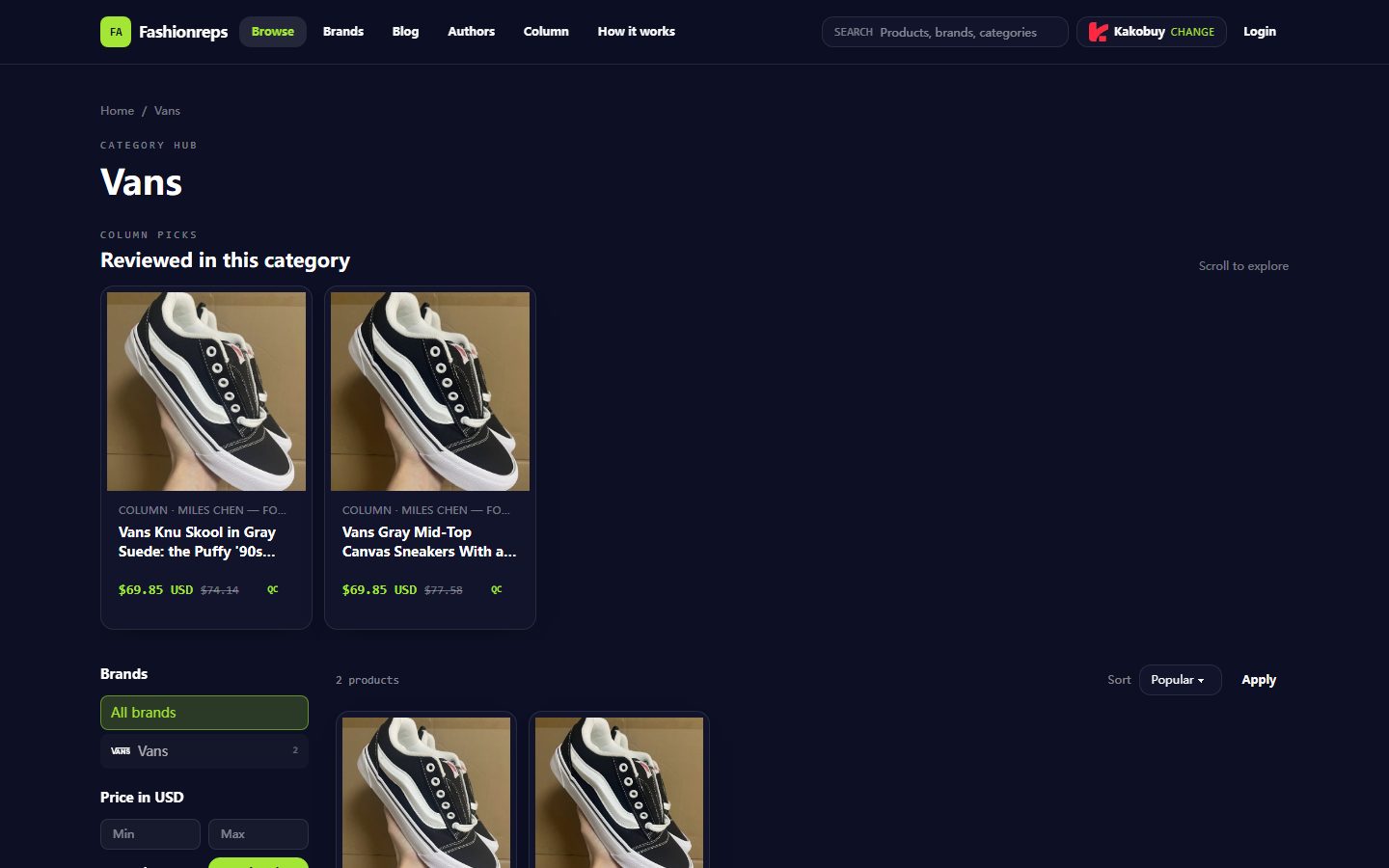
Fashionreps' Vans category page shows two product entries for reference: gray suede Vans Knu Skool, and gray mid-top canvas Vans shoes. The current reference price on the page records is $69.85 each; one entry's previous reference price was $74.14, and the other was $77.58.
These numbers can only be used as the reference prices shown on the product page at that time, not as the final purchase cost. The page does not provide the actual quantity purchased for this parcel, the seller's domestic shipping, warehouse weighing results, destination, international route, or taxes, so the complete landed cost cannot be calculated from this.
| Record Item | Information Confirmed This Time | Content Still to Confirm Before Ordering or Settlement |
|---|---|---|
| Product | Gray suede Knu Skool; gray mid-top canvas shoes | Size, stock, seller, actual purchase price |
| Page reference price | $69.85 per item | Whether it is the current price, and whether it includes discounts or regional differences |
| Quantity | Product page evidence does not provide the purchase quantity for this parcel | How many of each model, and whether combined with other fall/winter items |
| Product stage | Only the category page display information can be confirmed | Whether already ordered, warehoused, or inspected |
If you are selecting a shopping agent on the Fashionreps page, the agent selection on the page only indicates that the site provides a redirect entry, not that the agent has accepted the order, or that the route supports shoes, branded items, or delivery to the destination country. Before ordering, you should reopen the agent's product page to confirm that the product name, specifications, and price after redirect still correspond.
For Vans shoes, at least save the following information: product name, size, color, quantity, unit price, seller's domestic shipping, order number, and agent page screenshot. Do not disclose full order numbers, addresses, phone numbers, or payment information in the screenshot.
Weight, Dimensions, and Packaging Options to Record for Fall/Winter Shoe and Clothing Consolidation
When consolidating shoes and fall/winter clothing, packaging choices affect parcel volume, chargeable weight, and shipping protection. Shoe boxes usually protect the upper and sole but increase volume; removing the shoe box reduces volume but may decrease protection and may affect return or exchange eligibility.
Do not estimate parcel weight by product category without actual weighing. Shoe size, shoe box, filler, jacket fabric, clothing folding method, and waterproof packaging all cause differences. After warehouse warehousing, record:
- Individual actual weight and total actual weight after consolidation.
- Length, width, height, and whether any outer box protrusions are included.
- Whether the agent uses actual weight or volumetric weight.
- Whether shoe boxes, hangers, filler paper, and original packaging are kept.
- Whether reinforcement, waterproofing, or repackaging services are purchased.
- Whether any oversized, overweight, or route restriction warnings appear after consolidation.
For a pair of Vans shoes and several fall/winter clothing items, it is recommended to let the warehouse complete warehousing and inspection before deciding whether to consolidate. Without weighing data, you should not promise a shipping cost range in advance, nor apply the weight of someone else's parcel to your own order.
How to Decide on Packaging Options
Keeping the shoe box is suitable when you value shoe shape protection, need relatively complete packaging, or may request returns or exchanges. Removing the shoe box is suitable when you have confirmed you don't need original packaging and want to reduce volume, but you must first confirm the agent's return/exchange rules and warehouse operation restrictions.
Consolidation may reduce duplicate first weight or some handling costs, but it may also increase volumetric weight, single shipment loss risk, and parcel declared value. Splitting may increase fixed costs but can lower individual parcel weight or route restrictions. Neither approach can be directly considered cheaper.
Method for Separating Product Amount, Handling Fees, Payment Fees, and Packaging Fees
It is recommended to create a cost ledger, recording each fee separately, not just keeping the total on the payment page. The purpose is not to make the accounts look complicated, but to help discover if a fee is being double-counted, or if a fee is not included in the budget at all.
| Fee Category | Information to Record | Can the Amount Be Directly Determined This Time |
|---|---|---|
| Product cost | Unit price × quantity | Vans page provides reference price, but current actual price and quantity need to be verified |
| Mainland China shipping | Cost from seller to agent warehouse | Insufficient evidence, need to check order or seller settlement page |
| Agent service fee | Purchasing, warehousing, or other handling fees | Need to check current agent bill |
| Payment fee | Credit card, top-up, or payment channel surcharge | Need to check actual payment method and settlement page |
| Packaging fee | Consolidation, box removal, reinforcement, waterproofing, or repackaging | Need to confirm after selecting service |
| International shipping | Cost corresponding to destination, route, and chargeable weight | Cannot give specific value without destination, weight, and route |
| Customs declaration or filing fee | Declaration handling fee possibly charged by route | Need to check current route description |
| Destination country taxes | Import tax, sales tax, or customs-related fees | Depends on destination country, declaration information, and local rules |
The information about Kakobuy's fee structure is: total purchasing fee consists of product cost, international shipping, and customs declaration fee; product cost includes product selling price and Mainland China shipping; international shipping is calculated based on weight, route, and region; some routes may have customs declaration fees. This structure cannot replace the current bill, nor prove that every order will have the same fees.
If using a credit card or other payment method, also separately save the fees, exchange rate, and final deduction currency shown on the payment page. Products displayed in US dollars do not mean the agent will settle in US dollars; RMB accounts, US dollar cards, and intermediary payment platforms may use different exchange rates.
How to Verify International Route, Chargeable Weight, Exchange Rate, and Tax Basis
International shipping requires at least four pieces of information to verify: destination country/region, actual weight of the parcel, parcel dimensions or volumetric weight, and selected route. Missing any one of these can only be called a budget draft, not a final shipping cost.
1. First Confirm the Destination
Different regions within the same country may have different delivery conditions. Remote area surcharges, residential delivery restrictions, postal code restrictions, and prohibited item rules may all change route availability. Do not just fill in the country name and then treat search results as the final quote.
2. Distinguish Actual Weight and Chargeable Weight
The agent may charge based on actual weight, volumetric weight, or the greater of the two. Shoe boxes and fall/winter jackets tend to take up space, so even if actual weight is not high, volumetric weight may be triggered. Save warehouse weighing records, dimension records, and route descriptions in the same ledger.
3. Separately Verify the Exchange Rate
The knowledge base records Kakobuy's exchange rate as 6.22, but does not provide the time of this query, exchange rate type, applicable currency, or whether it includes payment channel spread. Therefore, this number can only be used as historical information, not directly for this payment budget.
When actually verifying, record the following:
- The original currency shown on the settlement page.
- The exchange rate used.
- The query time corresponding to the exchange rate.
- Whether it includes agent markup or payment channel fees.
- Whether the final bank debit amount matches the settlement page amount.
4. Do Not Treat Taxes as Agent Shipping Costs
International shipping is the transportation cost to deliver the parcel to the destination country or location, while taxes depend on destination country regulations, declaration information, product category, and local handling. Do not under-declare, split parcels to avoid taxes, or evade inspection just to lower the book amount. Declare truthfully according to destination country requirements, and confirm in advance the import regulations for restricted items, branded goods, and shoe/clothing items. ⚠️
How to Cross-Record Shipping Calculator Results and Settlement Page
The shipping calculator and the final settlement page serve different purposes. The calculator is suitable for comparing routes and estimating chargeable weight, while the settlement page is the actual amount source before submitting payment. When they differ, first identify the difference, not directly choose the lower number.
Recommended sequence:
- Wait for all products to be warehoused, and confirm the warehouse's actual weight and dimensions.
- Complete inspection, verifying style, color, size, quantity, and appearance information.
- Record packaging choices such as keeping shoe boxes, removing shoe boxes, reinforcement, and waterproofing.
- Enter destination, weight, dimensions, and product type in the shipping calculator.
- Save the route, chargeable weight, currency, and query time displayed by the calculator.
- On the settlement page, re-verify route, actual payment amount, payment fees, and estimated delivery time.
- Check for tax descriptions, remote area surcharges, or route restrictions.
- Only submit the parcel application when key fields match.
If the calculator shows an estimate, and the settlement page shows a new chargeable weight, the settlement page should prevail, and the reason for the change should be recorded. Common reasons include repackaging, increased volumetric weight, route switching, expired promotions, or added warehouse services.
Minimum Usable Fee Record Format
You can use the following fields in a table or memo: date, destination, product amount, domestic shipping, service fee, payment fee, packaging fee, actual weight, volumetric weight, chargeable weight, route, international shipping, customs declaration fee, tax description, exchange rate, settlement total, and screenshot location.
The point of recording is to preserve the source of each number, not to pursue a seemingly precise total from the start. Numbers without a source should be marked as "to confirm" rather than filling in an estimate.
Estimation Boundaries and Stop Conditions Without Real-Time Rates
Without real-time route quotes, destination, warehouse weighing, and settlement page information, this article cannot give a specific international shipping cost for this Vans fall/winter parcel, nor extrapolate the final landed cost. The only confirmable fact is that the product page once showed reference prices of $69.85 per item for two Vans products, and other fees must be added for the complete cost.
Stop estimating and wait for new evidence in the following situations:
- Product page price cannot be opened or the name is inconsistent after redirect.
- Product quantity, size, or stock has not been confirmed.
- Products have not been warehoused, and actual weight and dimensions are missing.
- The agent has not specified whether the route uses actual weight or volumetric weight.
- The settlement page does not show currency, exchange rate, or fees.
- Destination country taxes and customs clearance responsibilities are unclear.
- The shipping calculator and settlement page show different chargeable weights, and customer service has not explained.
- You plan to remove shoe boxes or original packaging, but return/exchange rules have not been confirmed.
In such cases, giving a seemingly precise total actually increases the risk of misleading. A more prudent approach is to keep product costs as a known item, list other items as "to confirm", and recalculate after warehouse data and settlement information are complete. 🔎
vans Parcel Pre-Submission Fee Checklist and Next Steps
Check each item before submission:
- Vans product name, color, size, and quantity are correct.
- Current product price has been re-verified on the agent page.
- Mainland China shipping has not been omitted.
- Inspection results match the product order.
- Consolidation or splitting plan has been compared based on actual weight and volume.
- Whether to keep shoe boxes has been confirmed and complies with return/exchange requirements.
- The international route supports the destination country, product category, and parcel dimensions.
- The calculation method for chargeable weight has been determined.
- Exchange rate, payment fees, and settlement currency have been recorded.
- Taxes, customs declaration, and clearance responsibilities have been read.
- The settlement page total corresponds item-by-item with the cost ledger.
- Screenshots have been redacted to hide address, phone number, order number, and payment information.
Actual Trade-offs of Consolidation vs. Splitting
Consolidation may save on duplicate first weight or some handling costs, suitable for users with multiple small light items within the same route restrictions and no significant volumetric weight risk after warehouse weighing. The increased risk is a higher per-parcel value, greater impact from a single shipping loss, and possible higher chargeable weight due to shoe boxes and jacket volume.
Splitting may increase fixed costs for multiple parcels, suitable for parcels that are overweight, oversized, have single-ticket route restrictions, or for those wanting to spread shipping risk. It is not suitable for splitting just to pursue a lower book amount, because multiple parcels may incur more handling fees, payment fees, and customs clearance steps.
Therefore, what really needs to be compared is: total payment after consolidation, total payment after splitting, chargeable weight for each option, parcel value, route restrictions, and customs clearance risk. If the settlement page does not fully display this information, you should not call one option more cost-effective.
Next Steps
First confirm the actual agent product page after redirecting from the Fashionreps page, then wait for product warehousing and inspection. After obtaining warehouse actual weight, dimensions, packaging options, and destination route quotes, create two cost ledgers for consolidation and splitting. Finally, use the settlement page to fill in item-by-item product fees, service fees, payment fees, packaging fees, international shipping, customs declaration fees, and tax descriptions.
If you are not satisfied with the received product, first save evidence of the unpacking appearance, product quantity, size, and damage location, then check the agent's current after-sales and return/exchange window. Information shows that Kakobuy once provided a 5-day unconditional return/exchange service within 120 hours after warehousing, but special products, items with removed packaging or tags, etc. may be excluded; this rule is time-sensitive, and actual handling must be based on the current agent page and order rules.
When judging product quality, combine order specifications, warehouse inspection photos, and the visible condition after receiving the actual item, focusing on checking style, quantity, color, size, model, and obvious appearance damage. Warehouse inspection is not a certification of materials, durability, or wearing experience, and cannot replace post-receipt inspection.
agent Platform Shopping FAQ
1. When I'm unhappy with an item I received through pandabuy, what steps can I take?
Get in touch with pandabuy's customer support as soon as you can. Most standard goods from Chinese sellers are covered by a 5-day unconditional return and exchange right. If you want to send it back, you may do so. If the package has already been delivered to you and you find a defect, contact pandabuy's support team so they can assist you in talking to the seller about a possible refund or remedy.
Here are support email addresses for reference:
kakobuy: service@kakobuy.com
oopbuy: support01@oopbuy.com
usfans: support@usfans.com
hipobuy: care@hipobuy.com
superbuy: care@superbuy.com
2. What's the best way for me to evaluate an item's quality on pandabuy before buying?
Look over the QC photos supplied by pandabuy; don't just rely on factory images, since those are usually edited. Use the QC photos to see whether the product fits your exact detail requirements before you decide to buy it.
Also, be cautious of products with very low prices, because they often turn out to be of poor quality.