Editor score 4.2 / 5
This post isn't about whether the shoes look like the real deal. It's about how to decide, when a fashionreps product page has limited info and comfort/durability haven't been independently verified, whether a Hoka shoe is worth further checking, asking the seller follow-up questions, or putting off the order.
We'll use the Hoka Bondi B3LS in black as a sample from the page. The listed reference price is $50.15, with a note that final item price, service fees, and international shipping should be confirmed by the shopping agent platform. Info was checked on September 26, 2026. Prices, stock, sizes, shipping, and link status can change, so don't treat the page records in this post as a current quote.

First, verify model clues, color, sizes, and visible specs on the fashionreps product page
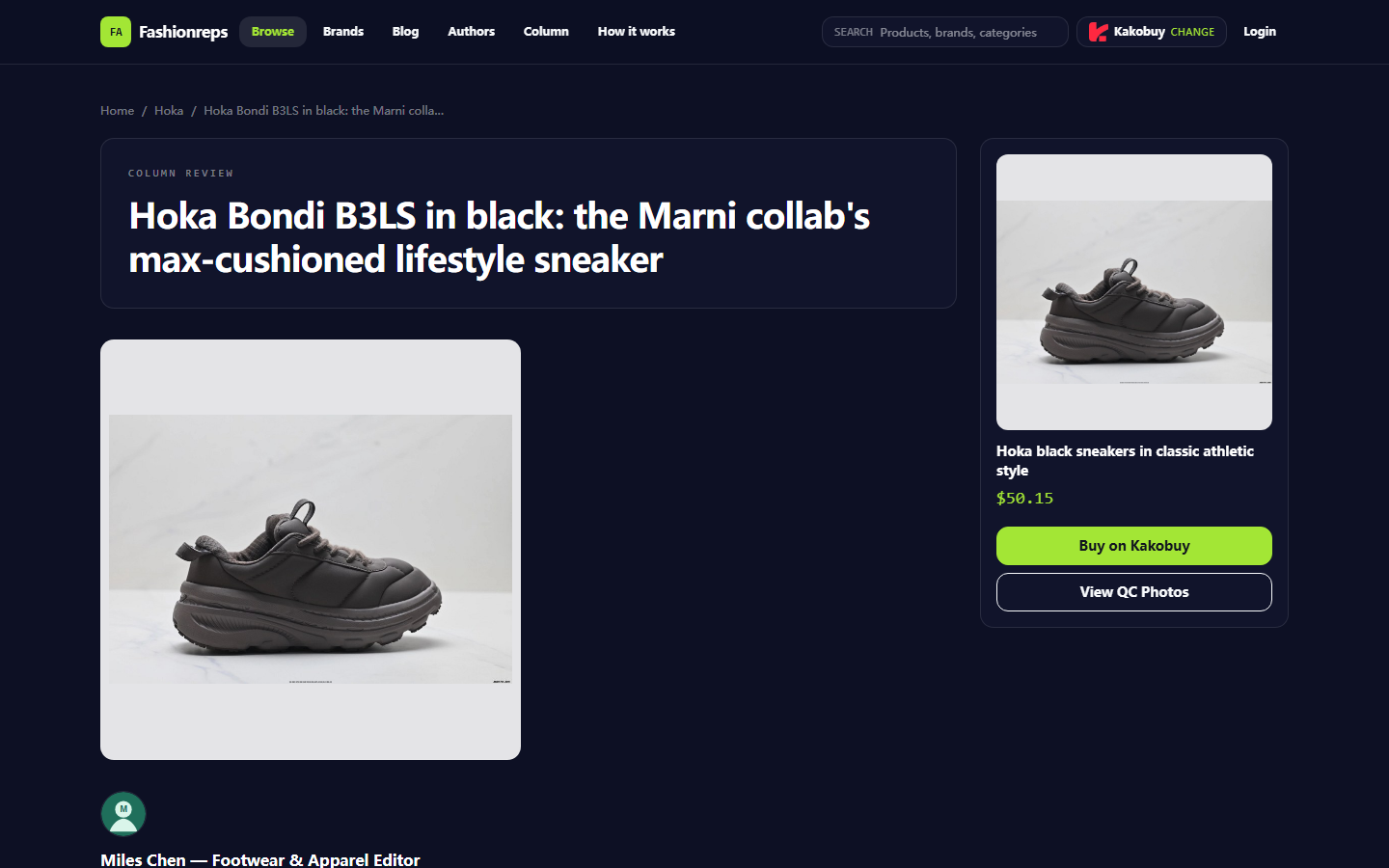
The sample page labels the shoe as Marni x Hoka Bondi B3LS, described as black, thick-soled, lifestyle-oriented sneakers. Key clues from the page include model name, colorway, thick midsole profile, upper paneling, and listed size range.
Distinguish three types of info:
- Direct product info on the page, such as name, color, reference price, visible sizes, and purchase link.
- Public discussions about the Bondi line or this collab, like the thick cushioning design, lifestyle positioning, and some buyers' sizing opinions.
- Things this specific product link alone cannot prove, such as actual comfort, long-term durability, authenticity, glue work, and actual weight.
There's a size inconsistency on the sample page: body text shows 36-45, while specs show 35-45. So don't just look at one size range and order. First confirm if your target size is actually available, and have the seller or agent clarify rules on missing sizes, size swaps, and additional photos.
What page evidence to look for in the upper, toe box room, and heel structure
A pre-purchase review isn't about zooming in to find "perfect details," but judging if the page evidence is enough to take the next step. Check in this order:
- Does the upper silhouette match the title and main image? For the black version, check if the colorway stays consistent across angles, avoiding mismatched versions in main, detail, and QC photos.
- Does the toe shape give enough room clues? Images can help judge if it's rounded, narrow, or sharply tapered, but can't directly prove width and toe pressure when worn.
- Are the tongue, eyelets, and heel fully visible? Blocked, overly cropped, or only distant shots reduce your ability to judge stitching, fit, and structural continuity.
- Are both left and right shoes in QC photos? Showing only one shoe prevents checking pairing, color differences, and side symmetry.
- Is the heel height and sole platform symmetric on left and right? Obvious angle differences may come from shooting, or reveal uneven placement or structural issues, so you need multi-angle photos, not a single angled shot.
"Max-cushioned" or similar descriptors on the page can hint at design intent, but don't mean this specific item has passed comfort testing. The editorial view can only propose verification methods based on visible materials, not claim personal purchase, wear, or receipt. 🔎
How outsole tread, platform shape, and walking scenarios correspond
The Bondi B3LS sample's page description emphasizes a thick, tall, geometric midsole, and public discussion usually views it as a lifestyle chunky shoe, not a performance trainer for intense running. This helps define use case, but doesn't replace physical inspection of rubber, flex, and grip pattern.
If your main use is city walking, daily wear, or styling, focus on asking:
- Is the forefoot tread clear and continuous;
- Any visible wear or dents on heel and forefoot;
- Any glue overflow, chips, or height differences on thick sole edges;
- Does the sole flex easily, and at expected location;
- Does midsole color in photos match upper and outsole.
If your main need is long-distance running, stability training, or specific foot support, don't decide based solely on a lifestyle model's page intro. Public opinion on the sample page also leans toward "can be used for light jogging, but not serious running." So performance runners should hold off and prioritize verifiable running shoe structure, sizing, and return/exchange terms. 👟
What main product images, QC photos, and user feedback each tell you
Three types of evidence serve different purposes. Mixing them up can overestimate reliability.
Main product images confirm style, color, overall silhouette, and page identity. They're usually curated and composed, good for judging "what the seller claims to sell," not for proving workmanship, comfort, or durability alone.
QC photos check visible condition before shipping. Buyers should request clear shots of both shoes, toe, sides, heel, sole, size tag, and label. Photos should include multiple angles and show upper seams, glue edges, and pairing. QC images are still just visual evidence at one point in time, not proof of long-term wear.
User feedback helps spot recurring issues like tight fit, sizing advice, hard sole, or appearance mismatch. But the sample page shows no approved reviews for this specific item, so you can't turn model-level public discussion into real buyer reviews for this link, or generate star ratings or "guaranteed authentic" conclusions. 📸
Comfort, durability, authenticity, and real-world wear that cannot be confirmed from the page
The following judgments cannot be made from the current page alone:
- Whether the toe box suits wide feet, high arches, or specific foot shapes;
- Actual midsole softness, rebound, and fatigue after long walks;
- Real feel, breathability, and abrasion resistance of upper materials;
- Long-term stability of glue, stitching, and sole bonding;
- Whether the item meets brand authenticity standards or has verifiable proof;
- Whether page images fully correspond to current stock batch.
Public sizing discussions for the Bondi line often suggest "true to size is snug, consider half size up," but the sample page explicitly says this isn't an independent fit report for this specific item. If you have wide feet, high instep, or are between sizes, prioritize providing foot length, width, and usual brand size, and ask the seller to respond based on actual insole or inner length. Don't treat "half size up" as a universal rule.
Pre-order checklist for Hoka shoes: sizing, extra photos, and info consistency
Before ordering, verify in this order:
- Record current model, color, size range, and reference price on the page.
- Confirm body text and specs match, especially the 35-45 vs 36-45 size discrepancy in the sample.
- Describe needs with foot length, width, and instep, not just "regular size."
- Request a full set of QC photos of both shoes, including toe, sides, heel, sole, size tag, and label.
- Check that QC photo colors, upper structure, and sole shape match main images.
- Ask about missing sizes, size exchanges, return/exchange window, and handling of failed QC.
- Reconfirm item price, service fees, international shipping, route restrictions, and potential taxes with the shopping agent.
- Save verification date and seller responses to avoid treating later changes as original page promises.
If a seller can't provide key angle photos or gives inconsistent answers on sizing, exchanges, or product version, keep the order status as "pending verification" rather than using low price to replace evidence completeness. 📏
Final action: decide based on evidence completeness whether to continue checking, ask questions, or hold off
Continue checking when: model and color info are consistent, target size is truly available, seller can provide complete QC photos, and price, service fees, international shipping, and after-sale terms have been reconfirmed with the shopping agent. Then you can proceed to QC inspection, but that doesn't prove authenticity or real-world performance.
Ask questions first when: size range has contradictions, shoe positioning doesn't match your needs, missing sole or size tag photos, or your foot shape greatly differs from common size advice. Get clear, saveable answers before deciding.
Hold off when: only main images are available, can't get both-shoe QC photos; page info conflicts with seller answers; you need serious running performance or confirmed authenticity; or the price seems cheap but service fees, shipping, taxes, and after-sale risks aren't yet calculated. ⚠️
This verification method may save rework costs from size errors, version mismatch, or obvious QC issues, but doesn't guarantee the lowest total price. The added cost is time spent waiting for extra photos, communicating, and possibly giving up on a pair. It suits buyers willing to check evidence first, mainly for daily styling or light walking; not for those who must buy immediately, require professional running performance, or can't accept cross-border after-sale uncertainty.