Editor score 4.2 / 5
Start with the Overall Color Palette
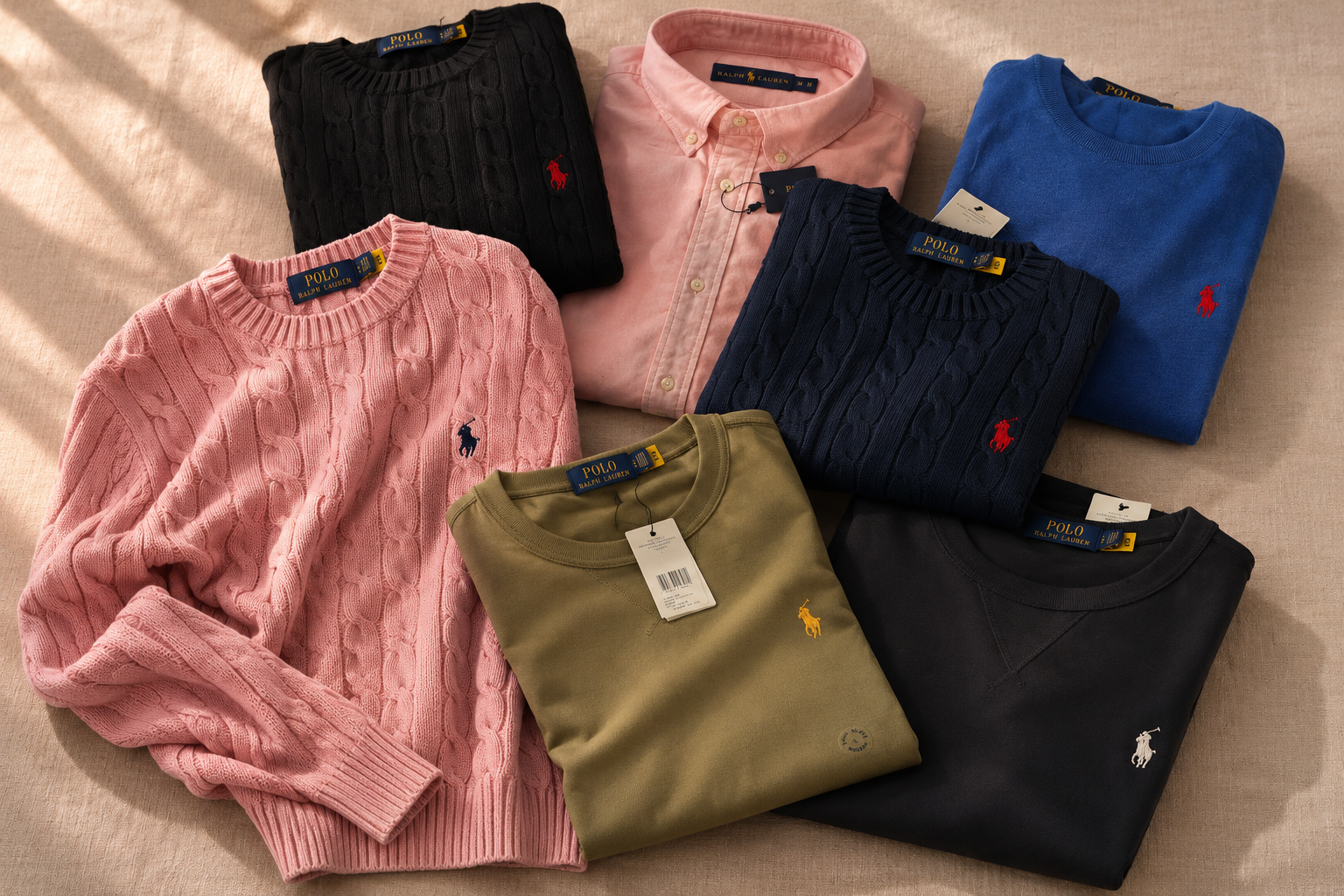
This flat lay uses black, navy, and bright blue to create depth and layering, with pink and olive green to adjust visual weight. Black and navy work as stable base colors, bright blue adds a punch of vibrancy, pink softens the overall look, and olive green brings a natural, casual feel.
If you want easier outfit combinations, start by choosing a main color and then add a dark or neutral top. For example, a pink knit sweater can be paired with black bottoms, a bright blue crewneck top works well with navy or black pieces, and an olive green top can be matched with beige, dark brown, or dark bottoms for a low-saturation look.

How to Style Knit Textures and Simple Designs
The black, navy, and pink knit sweaters in the image all feature cable-knit textures and ribbed necklines, with an equestrian motif on the chest as a focal point. Since the knit texture itself is quite prominent, pair with simple-lined pants or skirts to avoid too many complex patterns in the whole outfit.
The pink knit sweater has a striking texture and color, so it's best to tone down the sweetness with white, light gray, or dark pieces. The navy knit sweater easily fits into office or preppy styles, and the black knit sweater can be layered over a light-colored shirt, using the collar and hem to create contrast.
The light pink button-down shirt with its collar, placket, and light-colored buttons is clearly visible. It can be worn as an inner layer under a knit sweater, letting the collar peek out slightly to add a bright layer to black or navy tops. When displayed alone, the button placket can serve as a vertical line in the composition, creating variety against the surrounding crewneck styles.
Practical Tips for Flat Lay Displays
This image arranges multiple tops in an overlapping manner, with dark knit sweaters placed at the top and bottom, and bright blue, pink, and olive green interspersed to avoid clustering similar colors together. To recreate a similar display, arrange in the following order:
- Start with black or navy pieces as the visual anchor of the composition.
- Add pink and bright blue to create a transition from dark to light colors.
- Use olive green to fill the middle area, connecting cool and warm tones.
- Let some collars, cuffs, and hems overlap to show different styles.
- Place knit sweaters with prominent textures or chest motifs in more open areas for easy viewing of details.
The wooden table and warm lighting enhance the softness of pink and olive green, while also making black and navy appear with more pronounced light-dark contrast. When shooting or displaying, keeping natural wrinkles can convey the fabric's dimensionality, but avoid garments covering each other's collars, patterns, and main structures.
What to Focus on When Choosing
Details that can be directly judged from the image include color, neckline, surface texture, button placket, ribbed details, and chest motif. A flat lay cannot show how the garment fits when worn, nor can it be used to judge thickness, material composition, softness, wearing comfort, or durability.
Therefore, for outfit decisions, first filter by color and style, then refer to the specific product page for size information, length and chest measurements, material descriptions, and more construction details to determine if it suits your needs. If you prefer safe combinations, prioritize black, navy, and light pink. If you want to add a visual highlight, use bright blue or olive green as the single accent color in the entire outfit.