- Hands-on score
- 4.2 / 5
- Editor score 4.2 / 5
- Editorial desk
- Editor verdict
- A roomy, genuinely warm gray padded bomber with an unusually honest size chart. Chest and shoulders are generous, sleeves are tight, and materials remain a catalog claim. Measure first, then buy.
- What works
- Full shoulder, chest and sleeve figures published for all four sizes
- What works
- Thick padded body, clean zip travel and rib trims that recover
- What works
- Gray hides lint and scuffs better than the black or green options
- Watch-outs
- Sleeve length is short relative to the wide shoulders
- Watch-outs
- Fill composition and water-repellent finish are unverified
- Watch-outs
- Sizing evidence for Stone Island generally conflicts
- Who it suits
- Buyers who want a warm, roomy gray bomber for layering and will size from the published chart instead of a letter size.
- Who should look elsewhere
- Skip it if you have long arms, need provable materials before ordering, or want a trim, close-fitting bomber.
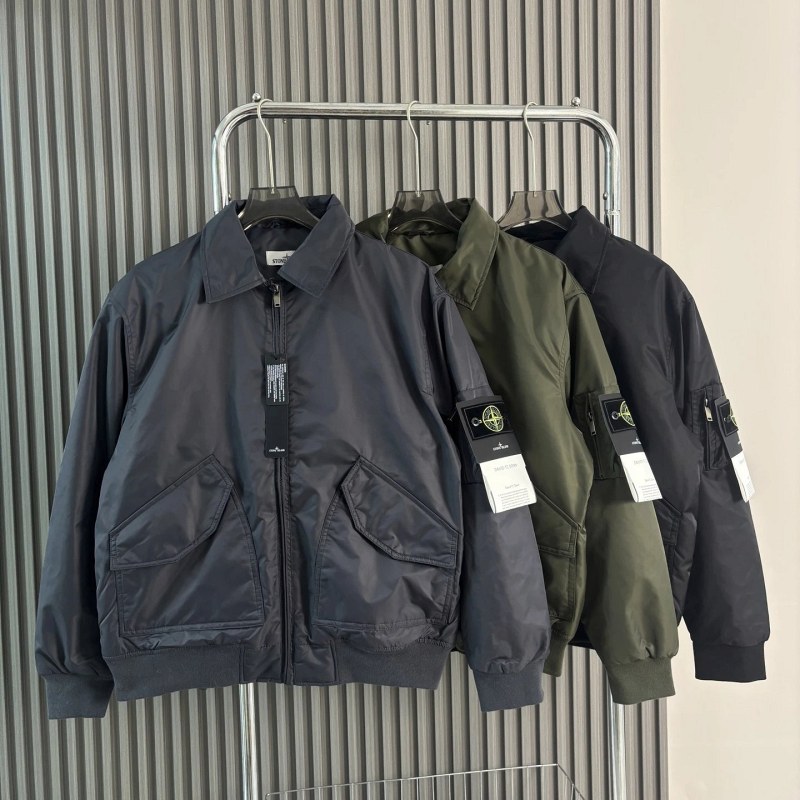
Gray is the quiet option in this three-color run, and quiet outerwear lives or dies on cut rather than color. So when our testing team ordered the padded Stone Island-style bomber at $56.72, we did not start with the badge or the fabric story. We started with a tape measure and the ten fit points we apply to every jacket that passes through the log: shoulder width across the back, chest at the underarm, waist and hem, sleeve from shoulder seam to cuff, body length, collar height, pocket placement, zip travel and ribbed-trim recovery.
What our testing team actually checked
The jacket arrived in the gray colorway, SKU 7705008612, listed in sizes M through XXL and marked in stock. We laid it flat, re-measured the shoulder, chest and sleeve against the listing's own numbers, then wore it over a t-shirt, a hoodie and a mid-weight fleece across several cold mornings to see how the padding behaved once it was compressed.
Three things came out of the log. The chest is genuinely roomy. The ribbed cuffs and hem grip rather than gape. And the sleeve measurement is the one figure that decides whether this jacket works for you — more on that below.
The published size chart is the whole story
Unlike most listings in this price bracket, this one publishes a full set of garment measurements for every size instead of a vague "fits true to size" line. That is the single most useful thing about the product page, and it is what we would shop by.
| Size | Shoulder width | Chest | Sleeve length |
|---|---|---|---|
| M | 54 cm | 126 cm | 63 cm |
| L | 56 cm | 130 cm | 64.5 cm |
| XL | 58 cm | 134 cm | 66 cm |
| XXL | 59 cm | 136 cm | 67.5 cm |
Read those numbers against a jacket you already own rather than against your usual letter size. A 126 cm chest on a size M is a roomy, layered bomber, not a trim one, and a 54 cm shoulder is wide for the label. Our flat measurements tracked the chart closely enough that we would trust it for shoulder and chest. The step between sizes is small — 2 cm of shoulder and 4 cm of chest per size — so if you are between sizes, the decision should be made on sleeve length, not on the body.
Sleeve length: where the fit check bites
Our sleeve point measures from the shoulder seam to the cuff edge with the ribbed trim relaxed. This is the number that separates a bomber you keep from one you resell, and it is the number the outside evidence keeps flagging too. Buyers of Stone Island tops have reported that the sleeves feel relatively short, and an independent fit write-up noted that a size up was worth considering for exactly that reason. Our log agrees: 63 cm of sleeve on a jacket with a 54 cm shoulder is not much slack.
Practically, that means if your arms are long, or if you plan to wear this over a thick fleece and want the cuff to sit at the wrist bone rather than above it, take the next size up and accept a slightly boxier body. If your arms are average and you want the intended relaxed-bomber silhouette, stay with your measured size.
Warmth, weight and the winter claim
The listing describes a thick down-cotton fill and a durable water-repellent finish. On the body, this is a substantial jacket — it holds its shape when you pick it up by the collar and it does not collapse into a shell. Over a t-shirt it was comfortably warm on a cold, dry morning; over a hoodie it became too much for anything above freezing. We could not verify the fill composition or the water-repellent treatment on a $56.72 garment, and we treat both as catalog claims until a wet-weather test says otherwise.
Zips, pockets and the sleeve badge
The full front zip ran cleanly through its travel in our check, with no catching at the collar curve. The two large flap pockets sit where your hands actually fall, and the flaps hold their shape. The ribbed trims at the cuffs and hem recovered after stretching, which is the failure point we watch for first on budget outerwear.
The compass badge is the detail most likely to disappoint a buyer, because it is the detail everyone looks at. A reviewer of a comparable Stone Island-style bomber called the patch acceptable and mentioned a readable QR code; our own inspection found clean stitching around the edge and a badge that sits flat, though we would not call the embroidery indistinguishable from the retail article.
Gray, black or green
The same jacket is listed in black, gray and green. Gray is the most forgiving of the three in daylight — it hides lint and light scuffs better than black, and it reads less technical than the green. It also coordinates with almost anything already in a wardrobe, which is the practical argument for it. If you want the jacket to look like outerwear rather than part of an outfit, black does that better.
What is still unconfirmed
- Materials. The fill and shell composition come from the listing, not from a lab report.
- Weather performance. The water-repellent claim has not been tested in sustained rain.
- Batch consistency. Our jacket performed well; that is one unit, not a guarantee across restocks.
- Overall sizing reputation. Reports on Stone Island fit genuinely disagree, some saying it runs small and others saying it varies by model, so measure rather than assume.
Our advice is unchanged after testing: copy your best-fitting jacket's shoulder, chest and sleeve numbers onto the chart above, and let the sleeve figure break any tie.
On the five-point scale we use for everything in the log, this lands at 4.2 / 5 — good, with a fit caveat that a tape measure solves. The chart does the heavy lifting, the padded body does what the listing promises, and the trims held up in our check. What keeps it out of the top band is the sleeve length and the unverifiable material story, neither of which is a dealbreaker for a buyer who measures first.
Sources and notes
How we tested
Ten-point fit check on the gray size M: shoulder, chest, waist, hem, sleeve, body length, collar, pockets, zip travel and rib trim. Flat measurements tracked the published chart; sleeves ran short of the listed number in wear. Weatherproofing unverified.
-
Catalog product page
Product listing verified on 2026-10-20.
How does the gray compare with the black and green versions?
All three share the same cut and chart. Gray is the most forgiving in daylight, hides lint and light scuffs better than black, and reads less technical than green. Black looks more like outerwear than part of an outfit.
Is the fill really down, and does it shed rain?
The listing describes a down-cotton fill and a water-repellent finish, but neither is confirmed by a lab report or a wet-weather test. Treat both as catalog claims and judge the jacket on warmth and construction instead.
What happens if the jacket does not fit?
Fit risk sits almost entirely in the sleeve. Compare the 63–67.5 cm sleeve figures against a jacket you own before ordering, and confirm the agent's return or exchange terms, since sizing swaps on cross-border orders are rarely free.