- Hands-on score
- 4.2 / 5
- Editor score 4.2 / 5
- Editorial desk
- Editor verdict
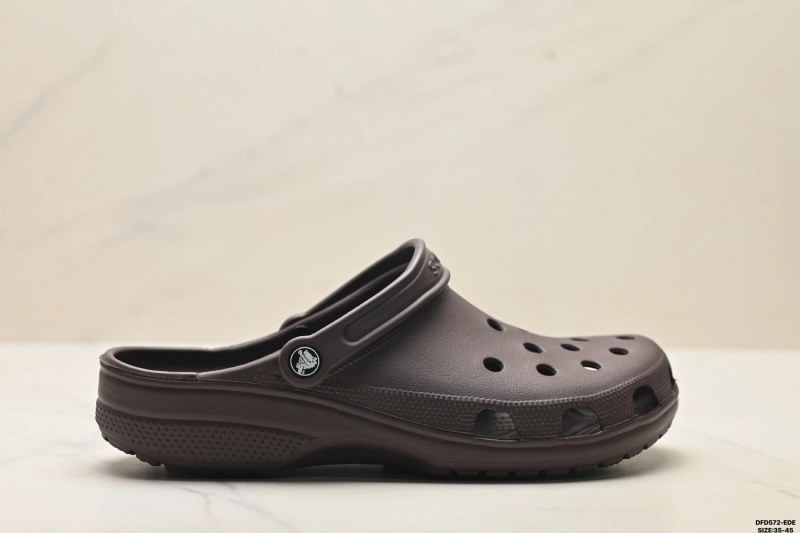
- A gray vented Classic clog at $15.67 that drains and dries well, under a title that describes a different product. Fit is permanent, so size carefully.
- What works
- Vented upper drains fast and rinses clean
- What works
- Whole-size run 35–45 covers most feet
- What works
- Low price makes it a low-risk trial
- Watch-outs
- Title says brown flip-flops; the pair is a gray clog
- Watch-outs
- Foam does not stretch, so a tight pair stays tight
- Watch-outs
- No half sizes, and published sizing advice conflicts
- Who it suits
- Buyers who want an inexpensive vented foam clog for errands, gardening, pools and short standing spells, and who will confirm the variant before ordering.
- Who should look elsewhere
- Half-size wearers who want a guaranteed fit, anyone expecting a brown flip-flop, and people planning long daily walks in a soft clog with minimal arch support.
The product page calls these "Crocs Brown Flip-Flops." The description on that same page describes a gray molded clog with a closed toe, an open back, ventilation holes across the top, a pivoting heel strap and a circular side button. We ordered a pair to see which version shows up, and then put it through our standard footwear checks: fit, retention, heat, moisture and a drop test.
A gray clog sold under a brown name
What arrived matches the description and the photography, not the title. There is no brown, and there is no flip-flop: it is the vented Classic silhouette, a slip-on with a closed toe box, a perforated upper and a strap that pivots from the heel to the instep. If color is the reason you are clicking, look at the variant image rather than the listing name. The "brown flip-flops" wording reads like a catalog label attached to the wrong product, and it is the single most confusing thing about this listing.
Everything else is present as advertised: the ventilation ports run across the top and along the toe box, the footbed is molded with a slightly recessed heel seat, and the outsole carries a shallow textured tread. The pair is listed in whole sizes 35 through 45, priced at $15.67 against an original $17.32, and marked in stock.
What our fit check actually covered
Clothing gets our ten-point check with shoulder width, sleeve length and waist measurement. A one-piece foam clog has none of those, so we adapted the same discipline to what this product can fail at:
- Footbed length and toe clearance, measured against a brannock reading rather than the printed size alone.
- Instep height and heel-seat depth, checked with and without a thin cotton sock.
- Strap retention in both positions, including a walk test with the strap forward on the instep.
- Lateral stability while turning on pavement, since there is no lacing to tighten.
- Surface condition after rinsing, after air-drying and after a waist-height drop onto concrete.
Two findings stood out. The heel seat is genuinely recessed, which keeps the foot from sliding backward but makes the fit read shorter than a flat slipper of the same size. And the strap, flipped forward, does almost nothing to hold the heel — it is a travel convenience, not a retention system.
Sizing: two official-sounding rules that contradict each other
This is where buyers get hurt, and it is not a problem we can resolve by picking a side. Retail listings for the Classic describe it as a "Roomy" fit and tell half-size wearers to order down to the next whole size. General Crocs buying guides say the opposite for anyone between sizes: order up, because half sizes do not exist. Community threads split roughly down the middle, with wearers reporting a half size smaller in one model and a half size larger in another. A Chinese-language guide recommends going up a full size because the recessed heel changes how the foot sits.
We tested around a 43.5 foot. The 43 fit snugly with the heel seated firmly and the toes just clear of the front; the 44 gave roughly a thumb's width of dead space ahead of the toes and required the strap at the heel to stop the shoe from feeling loose. Neither was wrong, but the 44 was the safer choice for anyone planning to wear socks, and the 43 was better barefoot.
The foam is the reason this decision is permanent: it does not stretch or break in, so a pair that feels tight on day one will still feel tight in month six.
Sweat, odor and where the venting stops
The holes are real and water exits them quickly — we ran the pair under a tap and the footbed was draining before we set it down. Air exchange is a different question. The upper is a closed-cell molded foam, and the same properties that make it easy to hose out also mean it absorbs nothing. Worn barefoot through warm afternoons, the footbed stayed noticeably damp, and the pair needed a full air-dry rather than a wipe.
Dermatology and podiatry commentary on foam clogs makes the same point from the clinical side: perforations do not guarantee a dry foot, and prolonged barefoot wear in a warm, non-absorbent shoe raises the risk of odor, maceration and fungal problems. Long-term wearers who rinse their Classics regularly report no odor at all, so the outcome seems to depend heavily on habits rather than the shoe alone. Our practical takeaway after the wear log: thin cotton socks, or a second pair rotated in, changed the experience more than anything else we tried.
Separately, foot-health specialists are consistent that a soft clog with minimal arch support is a short-trip shoe, not an all-day walking shoe, even though nurses and chefs widely wear the Classic for standing shifts. Both things can be true — standing in place and walking several miles are different loads.
Construction, cleaning and the drop test
The molding is clean, the side button is flush, and the strap pivot has no play. Rinsed and left in shade, the pair was dry inside a few hours. Dropped from waist height onto concrete, both shoes took visible scuffs on the outsole edge and a light mark on the upper, with no cracking, splitting or strap failure. The foam is soft enough that scuffs are cosmetic; it is not soft enough to conform to a narrow foot, which is the trade-off built into the material.
Value at $15.67, and what we could not confirm
At $15.67 this is well below typical retail for a Classic-style clog, and the whole-size run of 35–45 is broad enough for most households. The caveats are about the listing rather than the shoe. Independent reviews of this specific seller's stock are thin, the title does not describe the product, and the sizing guidance in circulation points in two directions at once. Confirm the size, the color of the variant you are sent and the condition of the pair with the seller before ordering, and treat the first ten minutes of wear as the real test: if the heel is jammed into the recessed seat with no clearance at the toe, a larger size will not break in to fix it.
Sources and notes
How we tested
Our testing team ordered a pair, measured footbed length and heel-seat depth, cycled the heel strap through both positions, wore them barefoot and socked on warm afternoons, rinsed and air-dried them, and dropped each shoe from waist height onto concrete.
-
Catalog product page
Product listing verified on 2026-11-01.
Is this product brown or gray?
Gray. The listing title says brown flip-flops, but the description and images show a gray vented clog with a closed toe and heel strap. Check the variant image and confirm the color with the seller before ordering.
Why do retailers disagree about sizing up or down?
Crocs labels the Classic a Roomy fit and some retailers advise half-size buyers to go down, while general guides advise going up because half sizes do not exist. Our test pair ran short at the heel, so try your usual size first.
Can they be worn at a pool or in the shower?
Yes. Water drains through the ports quickly and the pair air-dries without absorbing moisture. Dry them fully in shade rather than sun or a hot car, which can deform the foam, and avoid relying on them for grip on smooth wet tile.