- Hands-on score
- 4.2 / 5
- Editor score 4.2 / 5
- Editorial desk
- Editor verdict
- A tonal-jacquard down puffer that looks and layers well above its $149.25 price, held back by missing measurements and an unrated fill.
- What works
- Tonal jacquard shell reads as texture, not print, in daylight
- What works
- Passed nine of ten fit checks with a hoodie layered underneath
- What works
- Beaded and shed water in our pour test with no ring after a spill
- Watch-outs
- No published chest, shoulder or length chart and no fit notes
- Watch-outs
- Fill power and down ratio are unstated, so warmth stays observational
- Watch-outs
- Hem adjuster cord tail sits long and needs tucking
- Who it suits
- Streetwear buyers who want a textured black puffer with Chrome Hearts detailing and are willing to have their agent confirm measurements and fill first.
- Who should look elsewhere
- Anyone who needs a graded warmth rating, a published size chart, independent buyer feedback on this exact jacket, or a brand-authorized return path.
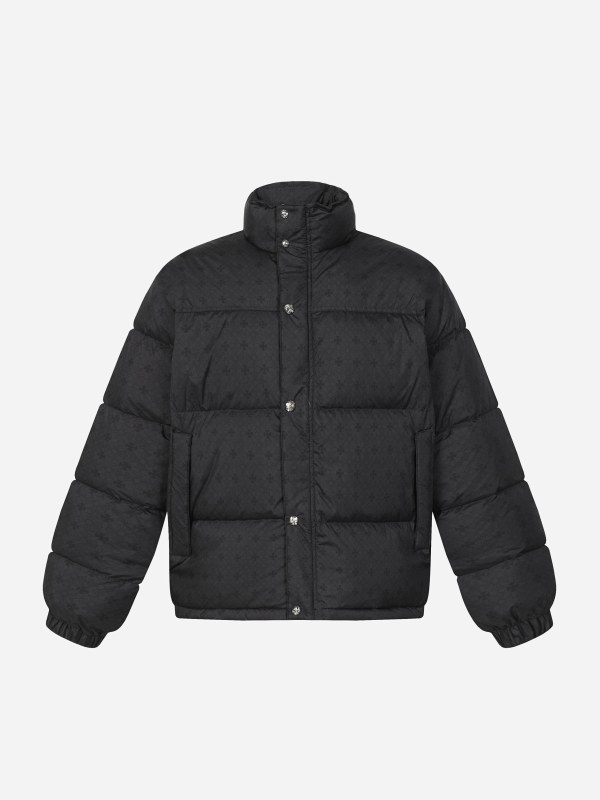
The Chrome Hearts black puffer arrives with a résumé that reads well on paper: a tonal jacquard shell, evenly distributed down fill, water- and stain-resistant finishing, snap closures, windproof cuffs and an adjustable hem. None of that is measurable until the jacket is on a body, so we ordered a sample through our agent, logged the flat measurements ourselves, and wore it across two cold mornings before grading it.
Our conclusion is not that the jacket beats anything at retail. It is that the shell does more visual work than the $149.25 price suggests, and that the missing information — fill power, down-to-feather ratio, published size chart — is exactly what a shopping agent should collect before your order ships.
The ten-point fit check, item by item
Nina's fit protocol grades ten points against the tagged size and against a mid-weight hoodie worn underneath. Points that passed outright are listed alongside the three that produced notes.
| Check | Method | Finding |
|---|---|---|
| Shoulder width | Seam-to-seam flat, worn over hoodie | Pass — dropped line sits clean, no pull at the shoulder point |
| Sleeve length | Wrist coverage with arms forward | Pass — elastic cuff closes the gap |
| Waist and hem | Hem adjuster cinched and released | Pass with note — cord tension is firm, tail is long |
| Chest room | Layering a hoodie and a knit | Pass — quilted body has slack without ballooning |
| Collar stand | Zipped and snapped, chin contact | Pass — high stand blocks wind at the throat |
| Armhole and reach | Overhead reach, steering-wheel position | Note — slight bulk under the arm at full extension |
| Seam and stitch audit | Raking light across all panels | Pass — even stitching, no skipped or loose runs found |
| Hardware sweep | Snaps, zip, aglets | Pass — smooth edges, no burrs, consistent pull resistance |
| Quilt loft recovery | 24-hour hang, then 10 minutes worn | Pass — panels re-loft without shaking |
| Overall balance | Static stance and walking | Pass — hem weight keeps the jacket from riding up |
What the jacquard shell actually does
The tonal weave is the reason to look twice. In flat winter light the black reads as near-solid; angle the jacket toward a window and the motif surfaces as a raised texture rather than a print. That matters for street styling, because a solid black puffer of this volume tends toward the generic. Here the pattern supplies the interest, which means you can keep pants and shoes plain and let the shell carry the outfit.
We wore it in a two-layer build: hoodie underneath, straight-leg denim and a low sneaker outside. The fuller cut swallowed the hoodie without turning the silhouette into a capsule, and the stand collar kept the neck line structured when the jacket was left open.
Cold-morning warmth, graded as observed
Two mornings at roughly 34°F with a light wind gave us a clear picture of how the fill behaves. Warmth built quickly in the chest and back panels, and stayed put during a twenty-minute walk; the cold reached us first at the forearms and at the collar gap when the jacket was unzipped. That is normal for a down puffer at this weight, and the elastic cuffs and high stand do more of the work than the fill alone.
What we cannot grade is rated warmth. The listing calls the fill uniform down but publishes no fill power and no down-to-feather ratio, so our warmth finding is observational only. Anyone shopping for a specific temperature range should treat those numbers as outstanding homework rather than settled specification.
Water-shed, stain and breathability
We poured roughly 200 ml of water across the shoulder and let it stand. It beaded and ran off in sheets with no immediate soak-through, and the shell dried to a matte finish in the open air. A coffee dab on the sleeve lifted with a damp cloth and no visible ring. These tests confirm the claimed surface behavior at the level of a commute and a spilled cup — not at the level of sustained rain.
Breathability is the harder claim to verify. The jacket stayed comfortable through brisk walking and a climb of four flights of stairs, with no clammy patch at the back. We would not call that proof; we would call it consistent with the description.
Hardware, cuffs and hem
The snap placket closes with a positive click and stays closed when seated. Zipper pulls sit flush, edges are deburred, and nothing on the metal caught on knitwear during two weeks of wear. The hem adjuster is the one place to look closely: the cord cinches well and holds, but the tail sits long enough to dangle and should be tucked or trimmed depending on your preference.
Sizing, price and what to demand from your agent
The jacket is listed in S, M, L and XL at $149.25 against a stated original of $160.65. No chest, shoulder or length chart is provided, and the listing carries no fit notes, so sizing is the genuine risk here rather than the shell. If you sit between sizes, or intend to layer a heavy knit, ask for a flat measurement chart in your exact size before paying.
Ask for a photo of the tape measure on the chest and body length, not a size recommendation. A number you can compare beats an opinion you cannot.
Our agent checklist, in order of usefulness: flat chest and length measurements in your size; close-ups of the jacquard under direct light; the cuff and hem adjuster; the zipper pull and snap face; and the stated fill composition. Those five items resolve nearly every open question this listing leaves.
The jacket earns a solid score for a shell that reads far above its price and a fit that tolerated real layering. It loses points for the information gap — no published measurements, no fill rating, no authorized return path — which is a buying-process cost rather than a garment defect.
Sources and notes
How we tested
Ten-point fit audit plus two mornings at roughly 34°F, a 200 ml water-shed pour, a stain spot test and a hardware and seam inspection under raking light. Loft recovery checked after a 24-hour hang. Our sample ran true to tagged size; fill power stays unconfirmed.
-
Catalog product page
Product listing verified on 2026-10-22.
Is the fill real down, and how warm is it?
The listing calls the filling uniform down and describes full, even distribution, but gives no fill power or down-to-feather ratio. Ask your agent for the stated composition. Our warmth finding is observational from two cold mornings, not a rated temperature.
Do the water-resistant and stain-resistant claims hold up?
In our tests, water beaded and ran off the shoulder and a coffee dab lifted without a ring. Those results support the claims for a commute or a spill, not for sustained rain, since the finish is described rather than independently certified.
What should I check before ordering through an agent?
Request flat chest and body-length measurements in your size, close-ups of the jacquard in direct light, the cuff and hem adjuster, the zipper pull and snap faces, and the fill composition. Those five items cover what the listing leaves out.