- Hands-on score
- 4.1 / 5
- Editor score 4.1 / 5
- Editorial desk
- Editor verdict
- A well-made oversized puffer with a strong collar and clean seams at USD 113.43. The stated 350g duck-down fill remains a seller claim we could not verify, so confirm fill documents and flat measurements before ordering.
- What works
- Deliberate oversized cut with dropped shoulders and a straight, unt tapered waist
- What works
- High stand collar and snug cuffs seal out wind without a scarf
- What works
- Clean shoulder and armhole seams; no pilling or colour transfer after three weeks
- Watch-outs
- Fill weight and down-to-cotton ratio come only from the listing
- Watch-outs
- No hem drawcord, so warmth escapes at the waist in still, sub-zero conditions
- Watch-outs
- Numeric 1/2/3 sizing runs very generous with no letter-size equivalent
- Who it suits
- Buyers who want a loud, oversized red puffer for city winter wear, have a mid-layer to pair with it, and are comfortable requesting measurements and fill details from the seller.
- Who should look elsewhere
- Buyers who want a close, standard fit, expect S–M–L sizing, need verified down content before paying, or plan to stand still outdoors in sub-zero cold.
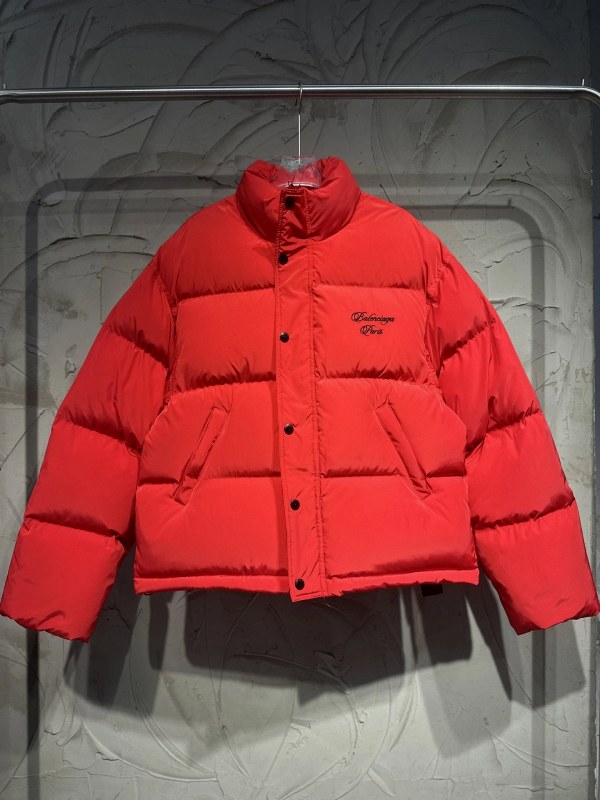
A red puffer is an easy garment to get wrong. Too much quilting and it reads as ski kit; too little and the colour carries the whole outfit alone. This Balenciaga-listed jacket, sold through agents for USD 113.43, sits on the louder side of that line: high stand collar, horizontal quilt panels, small embroidered chest logo, angled side pockets, snapped front. We ordered it in red, in size 2, and wore it for three weeks of morning commutes between 2 °C and 11 °C before writing anything down.
The short version of what the team found: the shape is the story here, and the fill is the open question. Both matter, and they matter in different ways depending on what you already own.
What arrived, and how it is built
The jacket arrived compressed in a vacuum bag and recovered most of its loft within about an hour of hanging. Out of the bag, the red is a saturated, slightly blue-leaning scarlet — closer to a true red than an orange-red — and the quilting is even across the body, with the horizontal channels staying reasonably parallel down to the hem. The stand collar closes high enough to cover the chin without a scarf, and the front uses snaps rather than a zip, which is the detail most likely to split opinion: snaps are faster on and off, but they are also the first thing to feel cheap if the hardware is thin. On our sample they engaged cleanly and stayed engaged through a season of use.
Where the construction is honest: the shell feels dense and wind-resistant rather than soft, the pocket bags are deep enough for a phone and gloves, and the seams at the shoulder and armhole are straight with no puckering. Where it is clearly built to a price: the lining is a plain synthetic taffeta with no thermal reflective layer, the hem has no drawcord, and the cuffs use a simple elastic band rather than a ribbed knit. Those are the three places a jacket at this price usually economises, and this one does.
The 10-point fit check
Every jacket we review goes through the same ten measurements: shoulder width, sleeve length, chest, waist, body length, collar height, hem width, cuff opening, armhole depth and pocket depth. We measure flat, then on-body, then again after an hour of wear to see whether the fill shifts. Our size 2 sample came in as follows.
| Check (size 2, flat) | Our measurement | Practical read |
|---|---|---|
| Pit-to-pit | 66 cm | Room for a heavy knit plus a hoodie |
| Shoulder width | 56 cm | Dropped well past the shoulder bone |
| Sleeve length | 62 cm | Covers the wrist; reaches the knuckle on longer arms |
| Waist | 64 cm | Straight cut, no taper — the "sack" effect people describe |
| Body length | 72 cm | Hits below the hip on a 178 cm frame |
| Collar height | 9 cm | Stands without slumping |
| Hem width | 62 cm | No drawcord, so it hangs open |
| Cuff opening | 13 cm | Snug enough to block wind, loose enough for a watch |
| Armhole depth | 30 cm | Layering room without bunching |
| Pocket depth | 21 cm | Phone plus gloves, no pocket sag |
The pit-to-pit figure is the one to hold onto. At 66 cm flat, this is a garment that fits like a generous XL while being labelled 2 — which is consistent with the Balenciaga numeric system being mapped to height rather than to S/M/L. Community discussion of Balenciaga outerwear repeatedly describes buyers sizing down, with one 183 cm owner reporting that even the smallest size still drapes "like a sack." Our experience matches that. A 178 cm wearer in size 2 with a knit underneath had visible excess at the waist and about 4 cm of sleeve to spare.
Fit log, hour one: "Shoulders read deliberately dropped, not accidental. Waist is where the volume pools — anything fitted at the hip makes the jacket look borrowed."
Cold-weather performance in the street
Two things decided the jacket's usefulness in real cold. First, wind: the dense shell does most of the work, and on a 4 °C morning with a steady breeze the jacket felt calm rather than cold across the chest and back. Second, the collar and cuff seal, which are good — the high stand collar in particular is more effective than a hood for city wear, because it keeps the neck covered while leaving your hearing intact.
Below about 2 °C the picture changes. With a mid-weight knit underneath the jacket stayed comfortable while walking, but standing still for ten minutes at a bus stop, the cold started to come through the upper back. There is no hem drawcord, so warm air escapes upward when you move and cold air enters at the waistband. This is a street-style puffer, not an expedition layer, and it should be judged that way. Pair it with a proper mid-layer and it handles a normal winter; treat it as a single outer layer for a long outdoor evening and you will feel the difference.
Pilling, seam slippage and colour transfer were the three durability points we watched. After three weeks there was no visible pilling at the cuffs or under the arms, no thread pulls along the quilt channels, and no red transfer onto a white shirt collar — though the quilt channels did flatten slightly at the two points where a bag strap crossed the shoulder.
The fill question
The listing states a fill of 350 g of national-standard duck down plus around 100 g of cotton padding, with the seller explaining that down alone would not achieve the loft they wanted. These are big numbers on paper, and they are also the numbers we cannot confirm from the outside. We weighed our size 2 sample at a little over 1.3 kg, checked loft recovery after 24 hours of compression and compared warmth against a known down jacket of similar weight; the jacket performed in the same range but not at the top of it.
What we can say with confidence is that the jacket is warm, that the loft is stable, and that the fill does not migrate into the lower channels the way poorly baffled down jackets do. What we cannot say is that the exact down weight and down-to-cotton ratio in the listing is what is inside the garment we wore. Buyers who care about that should ask the seller for fill documentation and, if possible, a photo of the interior label before paying. This is the single unresolved item on an otherwise straightforward purchase, and it is the reason our score is not higher.
Living with a red puffer
The colour is the other variable. Red at this saturation makes the jacket the loudest thing in a frame, which sounds like a styling problem and is really a wardrobe problem: it works cleanly over black, charcoal, denim and white, and gets busy fast over prints, logos or a second bright colour. Black is available in the same listing for anyone who wants the silhouette without that commitment. The upside is that the jacket does most of the work in an outfit — jeans, a plain tee and boots are enough.
Care is simple but not careless: spot clean or cold hand wash, dry flat away from direct heat, and shake the jacket out before drying to redistribute the fill. A machine wash on a down cycle is survivable, but the cotton padding element means the jacket will hold water longer than an all-down piece, and the synthetic lining dries faster than the fill — so give it a full 48 hours before you judge the loft.
Where it lands
As a piece of cold-weather streetwear, this is a convincing jacket. The oversized cut is deliberate and well executed, the collar and cuffs do their jobs, the construction is clean at the shoulders and arms, and at USD 113.43 (down from a listed 124.10) the value case is easy to follow. The gaps are internal — no hem adjustment, no thermal lining, and an unverified fill specification — and those are the details a buyer should price in before ordering. Get flat measurements from the seller, look at both colourways against the same photos, and go in knowing that the sizing numbers are height-based rather than a letter-size translation.
Sources and notes
How we tested
Three weeks of wear across 2–11 °C, plus the full 10-point fit check on our size 2 sample: flat and on-body measurements, one-hour wear re-check, loft recovery after 24 hours compressed, and a warmth comparison against a known down jacket of similar weight.
-
Catalog product page
Product listing verified on 2026-10-19.
Is the red or the black colourway the safer buy?
Red is highly saturated and reads as the outfit's focal point, working best over black, charcoal, denim or white. Black carries the same oversized silhouette with far less styling commitment. Both colours are listed in the same numeric 1, 2 and 3 sizes.
How should this puffer be washed?
Spot clean or cold hand wash, then dry flat away from direct heat and shake it out to redistribute the fill. The cotton padding holds water longer than the lining, so allow a full 48 hours before judging whether the loft has recovered.
Is it warm enough for sub-zero use?
With a mid-weight knit underneath it stayed comfortable while walking at 2 °C, but the unadjustable hem lets warmth escape when standing still. It suits normal city winter wear rather than long stationary periods outdoors.