- Hands-on score
- 4.2 / 5
- Editor score 4.2 / 5
- Editorial desk
- Editor verdict
- A clean-fitting, genuinely weather-shedding white shell at a low listed price. Fit and detailing impressed in testing; the light colorway and unstated membrane details keep it short of top marks.
- What works
- Holds a true-to-size technical fit through a 10-point check, with room for a mid-layer.
- What works
- Water beaded and rolled in our shower test; seam tape and front zip looked clean on our sample.
- What works
- Two vertical chest pockets stay clear of pack straps and hip belts.
- Watch-outs
- White finish showed faint cuff and collar marking after two washes — consistent with owner reports of yellowing and staining.
- Watch-outs
- Listing omits fabric, membrane, measurements and condition, so what arrives may differ from our sample.
- Watch-outs
- Some Arc'teryx hard-shell owners report delamination after light use; we could not test that over seasons.
- Who it suits
- Buyers who want a light-coloured technical shell, will confirm measurements and fabric with the seller first, and accept more frequent cleaning as part of owning white.
- Who should look elsewhere
- Anyone who wants a low-maintenance shell that hides dirt, or who needs documented condition and membrane details before paying.
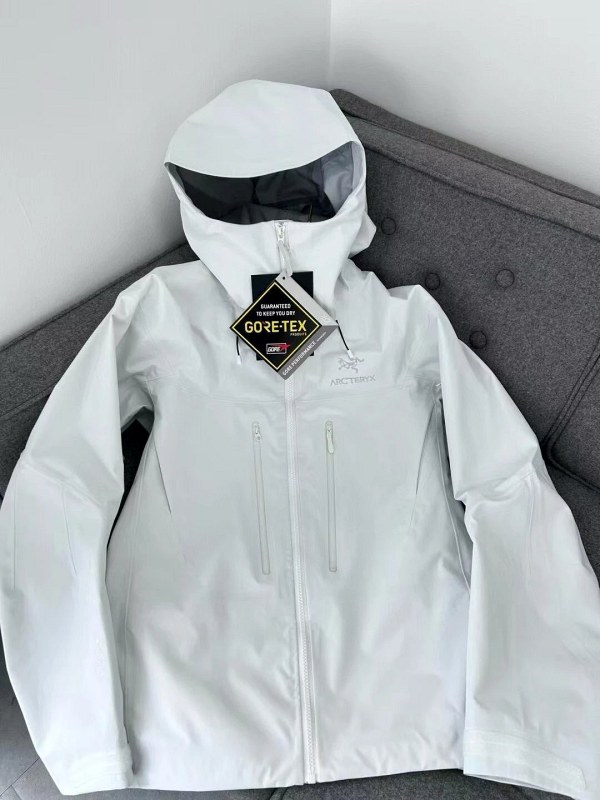
A white hard shell is a commitment, not a neutral basic. That was the first thing our testing team wrote in the shared log after unboxing the Arc'teryx White Waterproof Hard-Shell Jacket, listed at $137.31 against a $154.90 original price and available in S–XXL under SKU 7702033467. The second note was more encouraging: the cut is clean, the hood is attached and generous, and the two vertical chest pockets sit where a harness or a backpack strap will not fight them. This is a review of what we could actually measure, wash and wear — and of what the listing still leaves you to confirm.
Fit: the 10-point check
Nina's fit protocol runs ten stops — shoulder width, chest and pit-to-pit, sleeve length, cuff opening, waist, hem, hood depth, collar height and range of motion — and we ran all ten on a size M over a base layer and then over a mid-layer fleece. Shoulder seams landed on the shoulder point rather than hanging past it, sleeve length reached the wrist bone with arms forward, and the waist stayed close without pulling across the front zip when we reached overhead. Layering a fleece underneath tightened the chest slightly but never restricted the arms.
That matches the public guidance we trust most: Arc'teryx's own sizing help says that if your measurements fall between sizes, take the larger for a looser fit and the smaller for a tighter one, and that the men's fit was recently revised so smaller sizes are tighter and larger sizes looser. Owner threads on shell sizing lean the same way, with many people sizing up specifically to fit mid-layers. Our sample behaved like a true-to-size shell with a trim, technical silhouette — if you plan to wear a down or fleece mid-layer in cold weather, plan your size around that layer, not around a T-shirt.
Water, seams and the hood
We hung the jacket and ran a shower test across the shoulders, hood and chest for several minutes. Water beaded and rolled rather than soaking in, and the fabric darkened only where it pooled at the cuff hem. Under a lamp, the seam tape on the shoulders and hood read flat and continuous on our unit, and the front zip ran smoothly with a storm flap behind it. The high collar closes comfortably under the chin, and the attached hood turns with the head instead of dragging.
What we cannot do is confirm the membrane from a listing. The jacket shows a visible GORE-TEX tag at the front zip, but the seller text does not name the fabric, the membrane or the construction, and our shower test tells us about surface beading on one sample, not about breathability or long-term waterproofness in sustained rain. Treat the tag as a claim to verify, not a certificate.
The white colorway is the real test
Polar white photographs beautifully and shows everything. Across two home washes on a technical wash cycle and a re-proof, the shell kept beading, but we picked up faint grey marking at the cuff edges and along the collar where it rubbed against a pack strap. That is consistent with what owners of white and other bright Arc'teryx hardshells report publicly — visible yellowing and staining over time, and cleaning that is harder than with darker colorways.
Durability is the other open thread. Some Arc'teryx hard-shell owners report delamination after comparatively light use. We found no separation or bubbling on our sample after our testing window, but a few weeks of wear cannot settle a question that plays out over seasons, and the listing supplies no condition record for the individual jacket you would receive.
Details worth noting
- Two vertical chest pockets clear a hip belt and sit high enough to reach with a pack on.
- Dark interior lining is visible at the hood opening, which gives the white exterior a sharper edge and hides interior soiling.
- Full-zip front with a high collar and an attached, adjustable hood — a straightforward alpine shell layout rather than a fashion cut.
- Streamlined silhouette with long sleeves; no pit zips were listed, so ventilation depends on the front zip and collar.
Price and what to confirm before ordering
At $137.31 for a branded technical shell, the value case rests entirely on what arrives. The listing names the colorway and the S–XXL run; it does not state flat measurements, fabric or membrane details, weight, or condition. Before ordering, ask the seller for pit-to-pit, shoulder, sleeve and waist measurements for the exact size and colourway, close-up photos of the seam tape, hood adjusters and zipper pulls, and a clear statement of fabric and membrane. Then compare those numbers against the Arc'teryx size chart yourself. Our unit scored well on fit, weather shedding and detailing; the unknowns live in the listing, not in the jacket we handled.
Sources and notes
How we tested
Ten-point fit check (shoulder, chest, sleeve, cuff, waist, hem, hood, collar, range of motion) on a size M over base and mid-layer; shower test for beading; two technical washes and a re-proof; seam tape and zipper inspection under a lamp.
-
Catalog product page
Product listing verified on 2026-10-22.
Does this Arc'teryx shell run true to size?
Owners generally describe Arc'teryx shells as true to size, with many sizing up to layer mid-layers. Arc'teryx advises taking the larger size between sizes for a looser fit, the smaller for a tighter one. The listing gives S–XXL without measurements.
Is the white colorway hard to keep clean?
Yes — owners of white and bright Arc'teryx hardshells widely report visible yellowing and staining and harder cleaning than darker options. Our test unit picked up faint cuff and collar marking after two washes.
What should I confirm with the seller first?
Ask for flat measurements for your exact size, close-up photos of seam tape and zips, a statement of fabric and membrane, and the condition of the specific jacket, since the listing states none of these.